Jonas Plesnerjonasplesner.com
Business finance in plain English

The numbers, the structure and the pay behind a $7.5 billion business, explained so a student can follow

12 key figures. A real holding company and operating company structure with worked tax numbers. Salary chapters for the owner, the team and the top. Plus a spreadsheet toolkit to run your own numbers.

Get Fortune 500 Decoded for $497
One-time payment. Instant PDF download. 46 pages plus Excel toolkit.
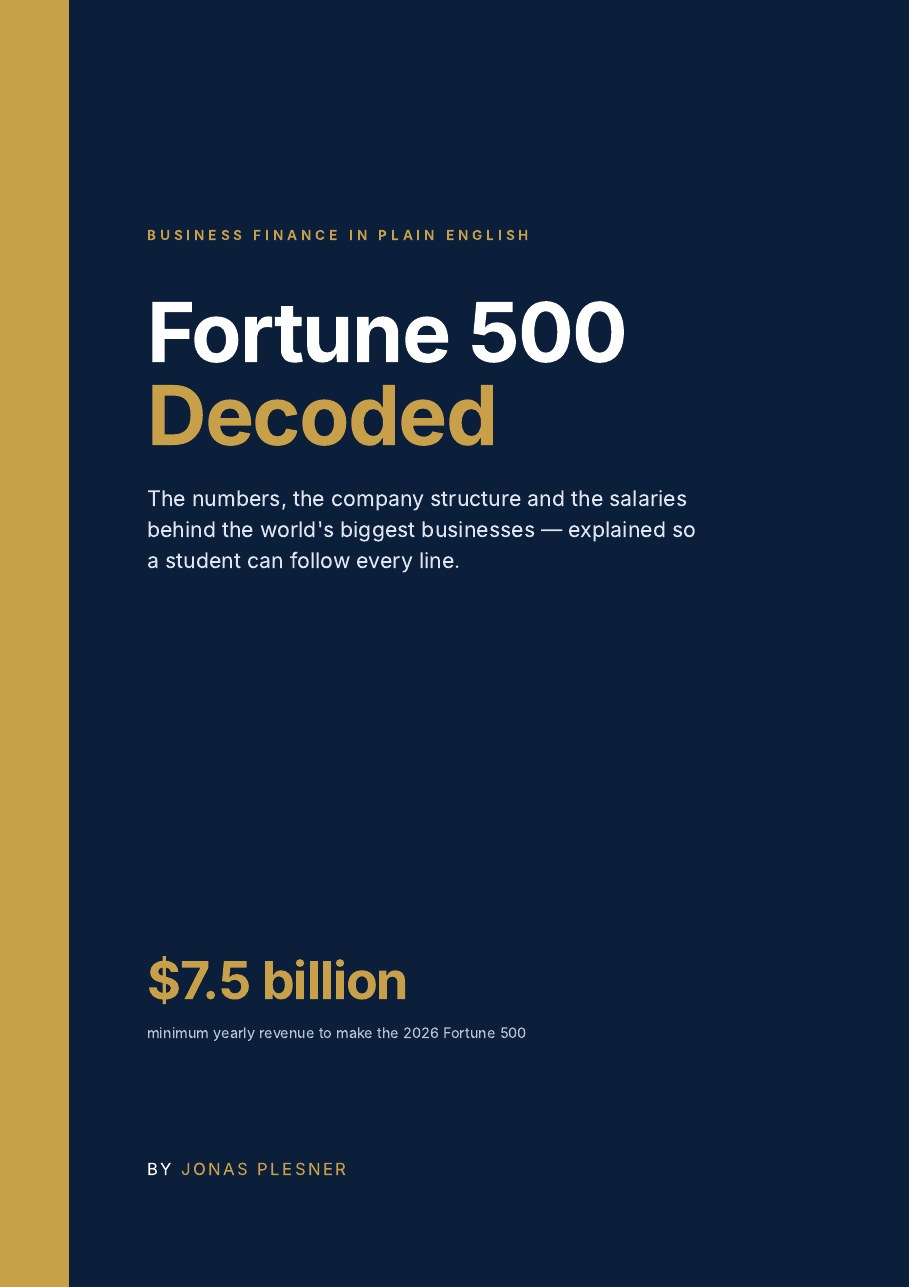
Cover of the ebook Fortune 500 Decoded by Jonas Plesner
$7.5Bminimum yearly revenue to make the 2026 Fortune 500
$20.5Mrevenue per day a company at the bottom of the list brings in
12numbers that tell you almost everything about a business

Dear Friend,

A company needs $7.5 billion in yearly revenue to make the Fortune 500. That is about $20.5 million every single day, weekends included.

Most people hear that number and decide it belongs to a different world. Different people, different rules, different language.

It does not. The biggest companies in America are measured with the same handful of numbers that apply to a business with five employees. They are built from the same building blocks: a legal company, a profit, a bit of debt, a cash balance, a payroll. They just have more of everything, and a structure that lets them keep growing without one bad day taking everything down.

The problem is that this knowledge is wrapped in accountant language. EBITDA. Working capital. Consolidation. Subsidiary shares. Participation exemption. Nobody explains it in normal words, so people nod in the meeting with their advisor and leave not knowing what they agreed to.

Three things most business owners never get explained properly

1. Which numbers actually matter. You can be profitable and still run out of cash. You can grow revenue every year and still destroy value. The scorecard in this book uses 12 numbers, and you can read all of them in two minutes.

2. How big groups are really built. Almost no large business is "a company". It is a family of companies: one on top that owns, others below that operate. Each one has its own risk, its own accounts and its own tax position. Nobody draws you that picture with real numbers.

3. How pay really works. When should you pay yourself salary and when dividends? What does one more employee really cost? How is a CEO paid at an S&P 500 company, and what can a small business copy from it?

Here is the kind of number this book puts in front of you. In the book's worked example, a company earns $3,000,000 before tax. Taken out personally as a dividend, the owner keeps $1,800,000 and the total tax is 40%. If the dividend goes to a holding company instead, $2,250,000 stays in the group to be reinvested, and the tax paid that year is 25%. The rates are invented round numbers; you swap in your own. The book shows every step, explains why that is legal, and explains clearly what it is not: the personal tax still comes when you take money out.

That is the difference between hearing about a holding company and understanding one.
Where do you stand today?

Try this quick calculator. Type your yearly revenue and a growth rate and see how far you are from the Fortune 500 line, and how long the road would take at that pace.

Your road to $7.5 billion

0.013%of the 2026 Fortune 500 minimum ($7.5B)
34.0 yearsto reach it at that constant growth rate

Illustration only: constant compound growth. Chapter 10 explains the maths and what it means in practice.

What is inside: 19 chapters in 3 parts

Every term is translated into plain English. One invented company, Brightline Bikes, carries all the examples in the numbers chapters, so you see the same figures from every angle.

Part 1: The numbers

  1. What "Fortune 500" really means
  2. The three reports every company lives by
  3. The income statement, line by line
  4. Margins: how much of each dollar you keep
  5. The balance sheet
  6. Cash flow: why profit is not money in the bank
  7. Debt: how much is too much
  8. Returns: ROE, ROA, ROIC
  9. Efficiency: days, people and payroll
  10. Growth and value: the road to $7.5 billion
  11. Your one-page scorecard

Part 2: The structure

  1. Why big companies are many companies
  2. A real structure: holding company and operating companies
  3. The tax logic, with numbers
  4. Setting it up the right way, and what never to do

Includes a diagram, the money flows, a yearly-profit example and an exit example, and a clear line between legal tax planning and tax evasion.

Part 3: The salaries

  1. Paying yourself: salary or dividends?
  2. Paying your team
  3. How pay works inside a Fortune 500 company
  4. Your 90-day plan

Plus a glossary, a formula cheat sheet and 13 questions to ask your accountant.

What you can do after reading it

What is included

Fortune 500 Decoded: 46-page PDF ebook, 19 chaptersCore
Toolkit 1: 12-number Scorecard (Excel). Enter your accounts, get all 12 numbers plus ROE, ROA, DSO, DIO, DPOIncluded
Toolkit 2: Growth Roadmap (Excel). Years to any revenue target at any growth rateIncluded
Toolkit 3: Owner Pay Calculator, any country (Excel). Salary vs dividend vs mixed at any profit levelIncluded
Glossary, formula cheat sheet, accountant questions, 90-day planIncluded
One payment$497

The Excel toolkit is pre-filled with the book's invented examples. Replace them with your own numbers. The tax calculator is a simplified learning model with invented rates: enter your own country's rates to use it.

This is for you if

This is not for you if

Why $497

This is not a $27 pamphlet. It is a complete reference for the three areas where business owners make their most expensive mistakes: reading the numbers, building the structure and paying people. It comes with working tools you will reuse every month.

For perspective: many accountants and tax advisers charge several hundred dollars for a single hour. This book gives you the language and the framework before that hour starts, so you spend the hour on your situation, not on explaining what EBITDA is.

The book's own examples show the scale of decisions involved: a $450,000 difference in tax paid in one year in the holding company example, and a $2 million tax on an exit when the shares are sold personally instead of through a holding company. They are examples, not promises. Your numbers will be different, and that is the point of learning to calculate them.

Get Fortune 500 Decoded

$497 one-time
  1. Click the button and pay securely with Stripe.
  2. Download the PDF ebook and the Excel toolkit straight away.
  3. Fill in the scorecard on your own numbers this week.
Get Fortune 500 Decoded for $497

Digital product. Payments are handled by Stripe.

Every Fortune 500 company started as a founder who did not yet understand the numbers. The ones that made it learned them. You can learn them in a weekend.

To your clarity,

Jonas Plesner

P.S. The first number in the book is $7.5 billion, and the last one you will actually use is the one on your own scorecard. Start there: get the book and the toolkit here.

Questions

Do I need an accounting background?

No. Every accounting term is translated into plain English the first time it appears. One invented company, Brightline Bikes, carries all the examples in Part 1, so you see the same figures through every report and ratio.

What does it take to be on the Fortune 500?

The Fortune 500 ranks the 500 largest US companies, public and private, by revenue. The minimum revenue to make the 2026 list was $7.5 billion. Chapter 1 explains what that does and does not tell you, and how revenue is counted for a group of companies.

Does it explain holding companies with real numbers?

Yes. Chapters 12 to 15 walk through an invented group with a holding company, an operating company and two asset companies. You get a diagram, the money flows, worked examples in dollars for yearly profit and for selling a company, a setup checklist, and a list of what never to do.

Is this tax advice?

No. It is educational material. Tax rules depend on your country, your company form and your situation, and they change. Have a qualified adviser check any structure or pay arrangement before you use it. The book is explicit about the difference between legal tax planning and tax evasion.

I live outside the United States. Is it useful in my country?

Part 1 (the numbers) and most of the pay chapters work anywhere. The book is written for an international reader. The tax examples use an invented Country X with round rates and amounts in US dollars. Most countries have comparable concepts (corporate tax, tax on dividends, rules for company groups) with different rates and conditions, and the book gives you the questions to ask a local adviser. The Excel calculator lets you enter your own rates.

What do I receive and in what format?

A 46-page PDF and an Excel toolkit with three tools: the 12-number Scorecard, the Growth Roadmap and the Owner Pay Calculator. Both are downloaded straight after payment.