Part 1
Foundations
- How a CFD works, long and short
- Spread, commission and overnight financing
- Leverage, margin and close-outs
- Choosing a regulated broker
A clear, step-by-step ebook that shows you how CFDs really work, how to read charts and the economy, and how to size every trade so one mistake can never wipe you out.
Secure checkout with Stripe · Read on phone, tablet or computer
CFD trading is speculating on the price of an asset — a stock index, currency pair, commodity, share or cryptocurrency — through a Contract for Difference (CFD) with a broker. You never own the asset. Instead, you and the broker exchange the difference between the price when you open the trade and the price when you close it.
You can buy (go long) if you expect the price to rise or sell (go short) if you expect it to fall. CFDs are traded on margin: you deposit a fraction of the position's value, so leverage magnifies both profits and losses. That is why successful CFD traders combine fundamental analysis (what to trade and in which direction), technical analysis (when and where to enter and exit) and strict position sizing (how much to risk).
Source: European Securities and Markets Authority (ESMA) product intervention measures on CFDs. Leverage limits: 30:1 major FX · 20:1 non-major FX, gold and major indices · 10:1 other commodities and non-major indices · 5:1 shares · 2:1 crypto.
Fundamentals tell you what to trade and in which direction. Technicals tell you when and where. Risk management decides how much — and whether you're still trading next year. The book is built in exactly that order.
43 pages, 15 chapters and 3 appendices — with charts, worked examples with real numbers, a pre-trade checklist and a fill-in trading plan.
Get the book — $27
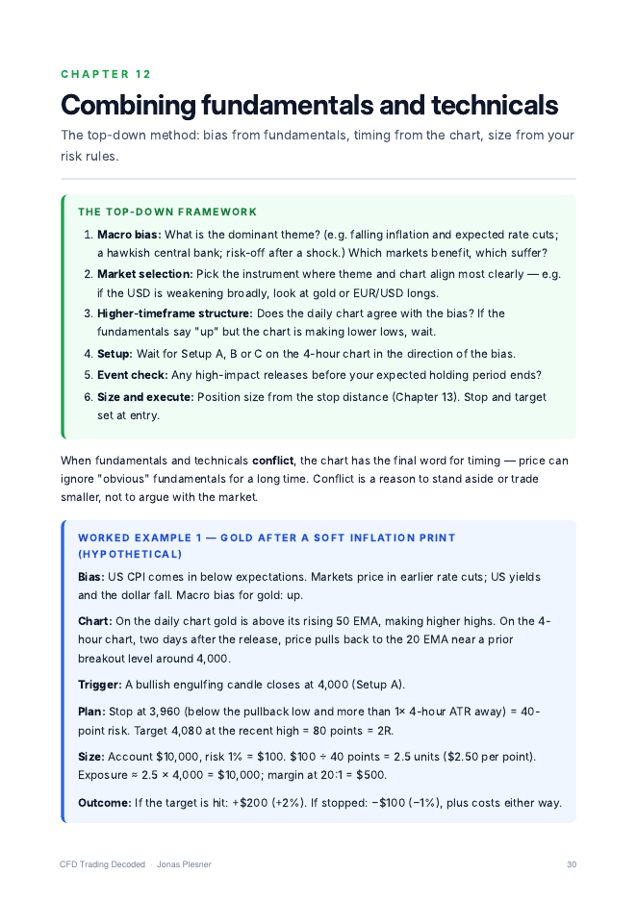
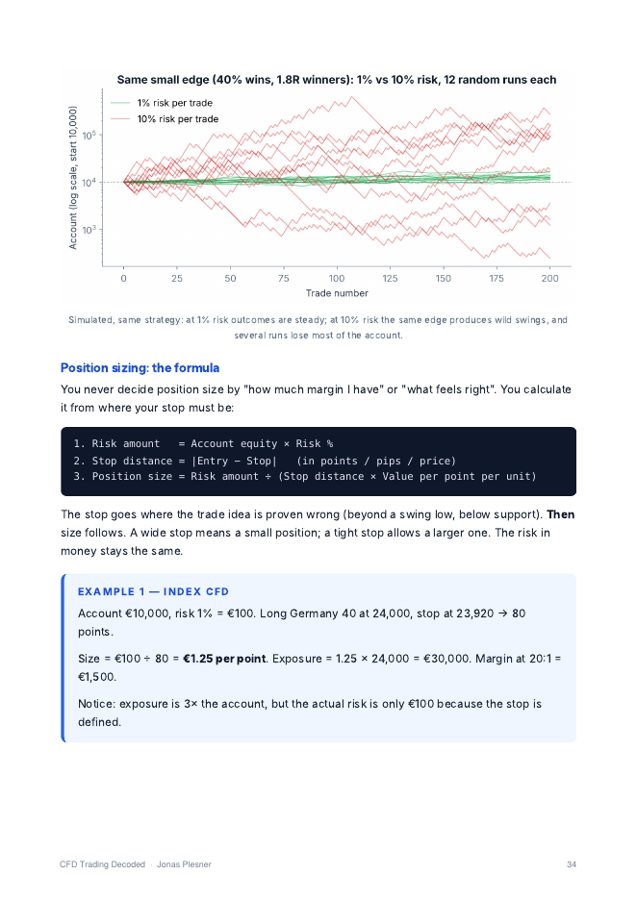
Position size = risk amount ÷ (stop distance × value per point). Enter your numbers to see how big your position should be — and how much margin and leverage it uses.
Illustrative only. Check contract sizes, minimum trade sizes and margin rates with your broker. Chapter 13 of the book walks through index, forex and share examples step by step.
CFD trading means speculating on the price of an asset — such as a stock index, currency pair, commodity or share — through a Contract for Difference with a broker. You never own the asset; you exchange the difference between the opening and closing price. CFDs can be bought (long) or sold (short) and are traded on margin, so leverage magnifies both gains and losses.
For retail clients of brokers regulated in the EU and UK, negative balance protection means you cannot lose more than the money in your account. You can still lose your entire deposit quickly because of leverage, and the protection may not apply with unregulated or offshore brokers.
Both. Fundamental analysis (interest rates, inflation, jobs data, earnings, sentiment) tells you which markets are likely to move and in which direction. Technical analysis (trend, support and resistance, indicators, chart patterns) tells you when and where to enter and where to place your stop-loss. Position sizing decides how much to risk.
ESMA rules cap retail leverage at 30:1 for major currency pairs, 20:1 for non-major pairs, gold and major indices, 10:1 for other commodities and non-major indices, 5:1 for individual shares and 2:1 for cryptocurrencies. Brokers must also close positions when equity falls to 50% of the required margin.
Brokers often allow small deposits, but the right amount is money you can afford to lose entirely. Start on a demo account, then trade live with the minimum position size and risk no more than 0.5–1% of your account per trade.
Most retail CFD traders lose money. European regulators found that 74–89% of retail CFD accounts lose money, and brokers must publish their own loss percentage. Consistent profitability requires a tested strategy, strict risk management and discipline — and is never guaranteed.
Beginners and early-stage traders who want to understand exactly how CFDs work and learn a structured method combining technical analysis, fundamental analysis and risk management before risking real money. It is education, not financial advice.
Payment is handled securely by Stripe. After payment you are sent straight to the download page, where you can download the 43-page PDF instantly. It works on phone, tablet and computer.
Get the complete CFD playbook — technical analysis, fundamental analysis, risk management and a 30-day plan — for less than the spread on a few bad trades.
Instant PDF download · Secure Stripe checkout